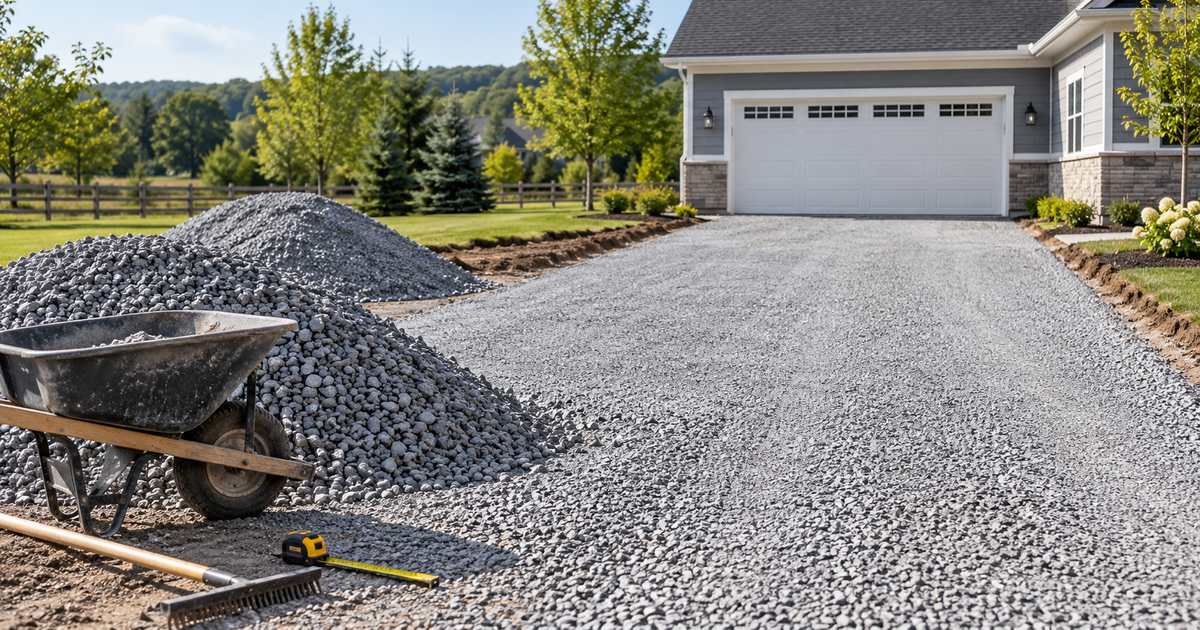
To budget for a gravel driveway, separate the amount of stone from the total cost of building the driveway. A useful estimate includes material quantity, supplier pricing, delivery, ground preparation, installation labor, equipment, possible drainage work, tax and a contingency for uncertainties. Do not rely on an average nationwide price to predict the cost of your property.
Begin with driveway dimensions and an appropriate design for local conditions. Convert each planned stone layer to cubic yards or tons, collect delivered quotes for the correct aggregate grades, then add the other services. An itemized budget gives you a much clearer picture than a single dollar-per-square-foot guess.
How to Budget for a Gravel Driveway
A driveway is more than loose rock spread over dirt. Its base and surface must work with the underlying soil, drainage, vehicle loads and local weather. Those conditions can determine whether a low initial quote is sufficient or whether the project needs substantial excavation and base preparation.
The Federal Highway Administration’s granular-base guidance explains that grading, particle durability and drainage influence base performance. The document is technical road guidance, not a price list or one-size-fits-all residential driveway detail.
Your budget should therefore use actual contractor or supplier quotes for the chosen construction plan. Avoid projecting local costs from an online example that has a different soil type, labor market or delivery distance.
Start by measuring the driveway footprint
Measure the driveway’s length and width in feet. For a rectangle, multiply them to find square feet. For irregular sections, divide the site into smaller rectangles and triangles, then add their areas. Note any turnaround or extra parking area separately.
Suppose your driveway is 30 feet long and 12 feet wide. The footprint is 360 square feet. If a specified layer is 4 inches deep, convert depth to 4/12 foot and multiply by 360 to get about 120 cubic feet. Dividing by 27 gives 4.44 cubic yards before purchasing allowances.
That calculation describes a layer, not the complete driveway structure. If the plan requires a subbase and a finish layer with different thicknesses, calculate each separately. The Crushed Stone Calculator can help with quantities and material assumptions.
Identify every stone layer and product grade
Not all aggregate is interchangeable. A dense-graded base contains smaller material that can help it compact, while some washed coarse stones are intended to leave more void space for drainage. The product selected for one layer may not be suitable for another.
Ask the contractor or supplier which material specification is required for each part of the driveway. Note the grade, stone source, installed thickness, loose bulk density and delivery unit. Those details are important because a quote for one product should not be compared directly to a cheaper but unsuitable substitute.
If a new driveway crosses wet or unstable soil, additional base stabilization or drainage may be needed. Do not include invented allowances for these conditions. Ask for a site-specific assessment and keep any suggested work on separate budget lines.
Understand whether stone is quoted by ton or yard
Suppliers may sell aggregate by loose cubic yard, US short ton, metric tonne or truckload. One cubic yard equals 27 cubic feet, while one US short ton equals 2,000 pounds. Volume and weight cannot be compared without a suitable bulk density.
If a supplier quotes by ton and your estimate is in yards, ask for that product’s loose weight per yard. Do not use a solid granite or limestone density to convert an aggregate pile. Moisture and grading can change the bulk weight, so a published number for another product is not a guaranteed conversion.
Record the supplier’s unit beside every quoted price. A price of 50 per ton and 50 per cubic yard may describe different total costs for the same intended volume. Use the Stone Cost Calculator to compare billable units and delivery rather than relying on the identical-looking price figures.
Include supplier minimums and delivery costs
The delivered material charge may differ from the cost of stone alone. Some suppliers have a minimum quantity, a truck fee or different charges for long trips and difficult access. A homeowner ordering a small quantity can face different unit economics from a contractor ordering several full loads.
Ask whether the quote includes loading, hauling, unloading, fuel charges and taxes. Confirm the unit of the order and how the supplier rounds partial tons or yards. A site that is narrow, steep or blocked by power lines may require different unloading arrangements.
Plan where the stone will be dropped before delivery. If the truck cannot access the placement area, extra labor or equipment may be needed to move the stone. Such handling work should appear as its own cost instead of surprising you after the delivery arrives.
Budget for preparation, excavation and grading
A contractor may need to remove vegetation or unsuitable surface material, shape the subgrade and establish drainage slopes before spreading aggregate. The amount of excavation depends on the approved design and existing soil. Do not assume every property needs the same depth of removal.
Ask whether excavation, hauling away soil and disposal fees are part of the quote. Keep those items separate from the stone purchase. If geotextile, stabilization or drainage work is specified, request materials and installation prices for those elements too.
Grading also affects driveway performance. The surface should direct runoff appropriately without sending it into a house foundation or neighboring property. Surface-drainage design can be more important to long-term maintenance than choosing one stone color over another.
Compare labor and equipment quotes fairly
Installation labor may be priced as a total project, by square foot or by hours plus equipment. Ask exactly which activities are included. One contractor’s price might cover spreading and compacting the stone, while another includes substantial site preparation and cleanup.
Equipment costs can include compactors, loaders, hauling machines and grading equipment. Avoid estimating hourly needs from a generic online average because soil conditions, site access and the number of layers can change the work. Ask the contractor for a written scope.
Compare bids using the same project plan and material specifications. A lower number is not necessarily a better value if it omits drainage, base preparation or the specified thickness. Request clarification of exclusions before deciding.
Add sales tax and a separate contingency
Sales-tax treatment can vary by location and by whether a charge is for materials, delivery or a contractor’s installed service. Do not assume the tax rate applies to every part of the invoice in the same way. Confirm the applicable rules or request a tax-inclusive quote.
A contingency is an extra budget reserve for reasonable unknowns. It is not the same as material waste. Waste changes how much stone you buy, while contingency changes how much money you reserve for unforeseen work or charges.
Choose the reserve based on the uncertainty of the project and professional advice. A straightforward resurfacing job may differ from a new driveway with unknown soil conditions. Record the contingency separately so you can see the cost of planned work without confusing it with an emergency buffer.
Build a simple itemized example
Suppose the project needs 5 billed cubic yards of material after rounding, priced at an illustrative 55 currency units per yard. The stone line would be 275. If delivery is quoted at 75, and installation labor at an assumed 540, the subtotal before tax and other work would be 890.
Those prices are examples chosen to explain addition, not current US market averages. Add the actual supplier charges, site-preparation costs, applicable sales tax and contingency to obtain a meaningful personal budget. If the design needs more than one stone layer, repeat the material line for each product.
A cost table is easiest to review when it separates material, delivery, labor, excavation, drainage, equipment, sales tax and reserve funds. Keep notes about the selling unit and assumptions beside each line. This gives you a record you can revise if quotes change.
Get a complete quote before scheduling work
Send each contractor the same plan, measurements and product specifications. Request the expected project sequence, estimated quantities, payment terms, responsibilities and any required permits. Confirm which site conditions would lead to a change order.
Ask how the job will be inspected or accepted, particularly for compacted base materials. A quantity estimate alone does not verify finished thickness, grade or density. If the driveway serves heavy vehicles or slopes toward important structures, seek qualified design input.
Keep all quotes, material tickets and final invoices. They are useful if you need to calculate future top-ups, compare maintenance costs or resolve a disagreement about the delivered quantity. The clearer your budget, the easier it is to track changes.
FAQs: How to Budget for a Gravel Driveway
Q. Can I get an exact driveway price from dimensions alone?
A. No. Dimensions give a quantity starting point. Local material prices, site preparation, labor, drainage and delivery affect the actual cost.
Q. Should delivery be included in the price per ton?
A. It depends on the supplier’s quote. Request separate material and hauling charges or one clearly identified delivered total.
Q. Is gravel waste the same as budget contingency?
A. No. Waste increases stone quantity; contingency reserves money for uncertain costs.
Q. Can I compare contractor quotes by square foot?
A. Only when the scopes and material specifications are the same. Compare excavation, layer depths, compaction and drainage separately.
Conclusion
The best way to budget for a gravel driveway is to measure the job, use an approved material plan and compare complete local quotes. Separate stone, hauling, labor, preparation, tax and contingency, then try the Stone Cost Calculator to assemble a transparent estimate.
Disclaimer
This guide is general educational budgeting information, not a contractor quote, engineering design or tax advice. Costs and requirements vary by location and site conditions. Verify figures and specifications before committing to work.